Example sentences in dictionaries: More important than definitions
In an English dictionary, example sentences are even more important than definitions. A definition does one job: it tells you what a word means. Example sentences, on the other hand, perform at least three tasks:
- They let you check if you’ve understood the definition correctly.
- They show you how to use a word in sentences — how to connect it with other words and with grammar structures.
- They program your brain to produce correct English sentences.
Understanding meanings
After reading the definition of a word, you can read the example sentences which contain the word. If you can understand them, you know you’ve understood the definition correctly. For example, it is nice to read that surpass means “to go beyond in amount, quality or degree”, but it is even nicer to see an example:
You’ll probably agree that after seeing the sentence, the meaning of the word surpass becomes much clearer and easier to remember.
Sometimes a definition is so complicated that the example sentences are your only hope. Consider this definition from the Collins COBUILD Advanced Learner’s Dictionary, an otherwise fine product:
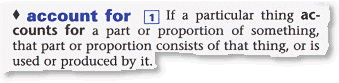
“That part or proportion consists of that thing”? Yeah, whatever. Let’s see the example sentence, which makes things a lot clearer:

Grammar and usage
A definition tells you what a word means, i.e. it helps you understand the word when you see it. However, the meaning is only half of the picture. In language, there are not only meanings, but also grammar and collocations. Some words simply “go with” other words.
- For example, the verb to suffer goes with the preposition from (as in “Alice suffers from insomnia”), and not with some other preposition.
- Lethal and mortal both mean “deadly”, but we only talk about a lethal injection, not a mortal one.
- The adjective major has the same meaning as important, but it must come before a noun (as in “Drug abuse is a major problem” or “Religion has played a major role in the history of mankind”), so it would be wrong to say “It is major to remember people’s birthdays”.
- Danger (definition: “the possibility of something bad happening”) is often used with in (“Our lives are in danger”), with of (“The building is in danger of collapsing”), or with a that-clause (“There’s a danger that the plan will fail”).
Such information is often not found in the definition, and you need to read the example sentences to learn how to connect a word with other words to produce correct sentences.
But — you might say — most dictionaries for English learners include grammar/usage information in the definitions. You would be right, of course. For example, the entry for suffer might include the label + from; or major might be labeled with something like adj + n to show that the adjective must come before a noun.
However, such “codes” can be tricky to interpret. A person who only knows that suffer means “to feel pain” and goes with the preposition from may produce the perfectly logical sentence “I suffer from doing homework” rather than “I suffer when I have to do homework”. It is also easier to remember one or two example phrases (e.g. “major problem”, “to play a major role”) than to remember the abstract rule: “major has to be followed by a noun”.
Brain programming
When you speak your native language, you don’t have to think about grammar rules to produce a sentence; phrases just appear in your mind and they are all correct. You don’t have to be especially intelligent or have an exceptionally good memory to speak your native language without mistakes.
This is possible because the brain contains a special language module. The module collects sentences from your environment, and imitates them and re-combines them to produce new sentences. This is exactly how you learned to speak as a child: you listened to your parents and other people around you, and then you were able to imitate those sentences.
You learn a foreign language in the same way. As you hear (or read) more and more correct English sentences, your language module gets more and more information, and you can express more and more in English. It’s called learning by input.
Now you see why it is a good idea to read the example sentences when you look up a word in a dictionary. For each sentence you read, there is a good chance that it will appear in your head when you need it, and that you will be able to re-use it (or part of it) to produce your own correct sentence.
One more example
We have said that example sentences give important grammar/usage information and program your brain to produce its own sentences. Let’s see one more example of how this works.
Suppose we look up the word shroud in a dictionary and find this definition:
![shroud [(in) usually pass.] to cover and hide](shroud-noex.gif)
--Longman Dictionary of English Language and Culture
Great, so now we know what shroud means. It means “to cover and hide”. We even know that we usually use shroud in the passive voice with the preposition in. But can we really use the word shroud, i.e. can we make our own sentences with it?
For example, you could say “I was hidden in the corner” — but would it be OK to say “I was shrouded in the corner”? Or, you could say that “The street was covered in darkness” — but could you say “The street was shrouded in darkness” instead?
Well, we don’t know that. All we know is, shroud is probably not used in the same way as cover and hide, but the definition does not say in what situations (contexts) it is used. So after seeing the definition, we know what shroud means, but we still can’t do anything useful with it.
Now let’s read the definition with example sentences:
![shroud [(in) usually pass.] to cover and hide; The hills were shrouded in mist. The whole affair was shrouded in mystery.](shroud-ex.gif)
What do these examples tell us? They tell us many things:
- We usually say that something is “shrouded in something”, and not, for example, that “something shrouds something”. We could have learned this from the definition, which says that shroud is followed by in and usually appears in the passive voice (“usually pass.”), but examples are nicer than codes.
- Both physical (hills) and nonphysical (affair) things can be shrouded in something.
- Things can be “shrouded in mist” or “shrouded in mystery”. “Shrouded in the corner” will probably sound strange to native speakers.
With this information, you are finally prepared to use the word shroud in speaking or writing. For example, you can imitate the example sentences and say “The negotiations are shrouded in mystery” or “The street was shrouded in fog”. This imitation can happen consciously (if you look at the examples while writing your own sentence) or in the magical “learning by input” way (if, say, in a week, you’re writing a composition and the phrase shrouded in something appears in your head because you have seen some sentences with it).
Final advice
- First, make sure your dictionary has lots of example sentences. Better yet, use two or more dictionaries.
- The next time you look up a word in a dictionary, and you want to use that word in your own speech or writing, concentrate on the example sentences — maybe even try to memorize them. You will not only learn incredibly useful information on the word’s usage; you will program your brain to produce similar sentences. You’ll be surprised at how much your brain can do if you feed it with enough input.