Review of the Collins COBUILD Advanced Learner’s English Dictionary
6th edition
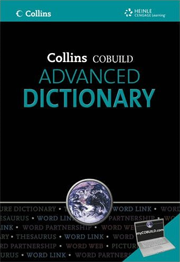
The 6th edition, published by HarperCollins in cooperation with Heinle Cengage, appeared in bookstores and on Amazon in late 2008. It has a radically different cover design and a new, shorter name: Collins COBUILD Advanced Dictionary, but the content is almost identical to the 4th and 5th editions. Here are the main differences:
- A few fairly useless new entries (e.g. Bluetooth, open-source) that you can look up on Wikipedia
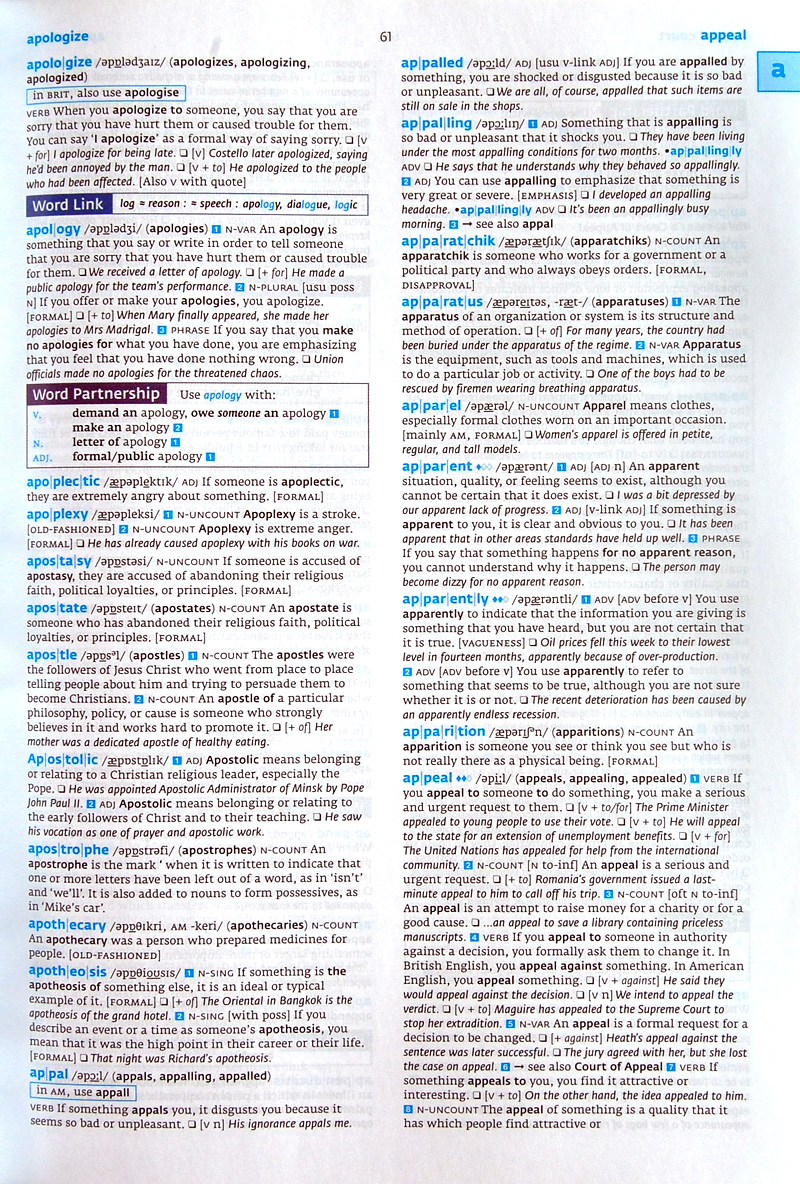
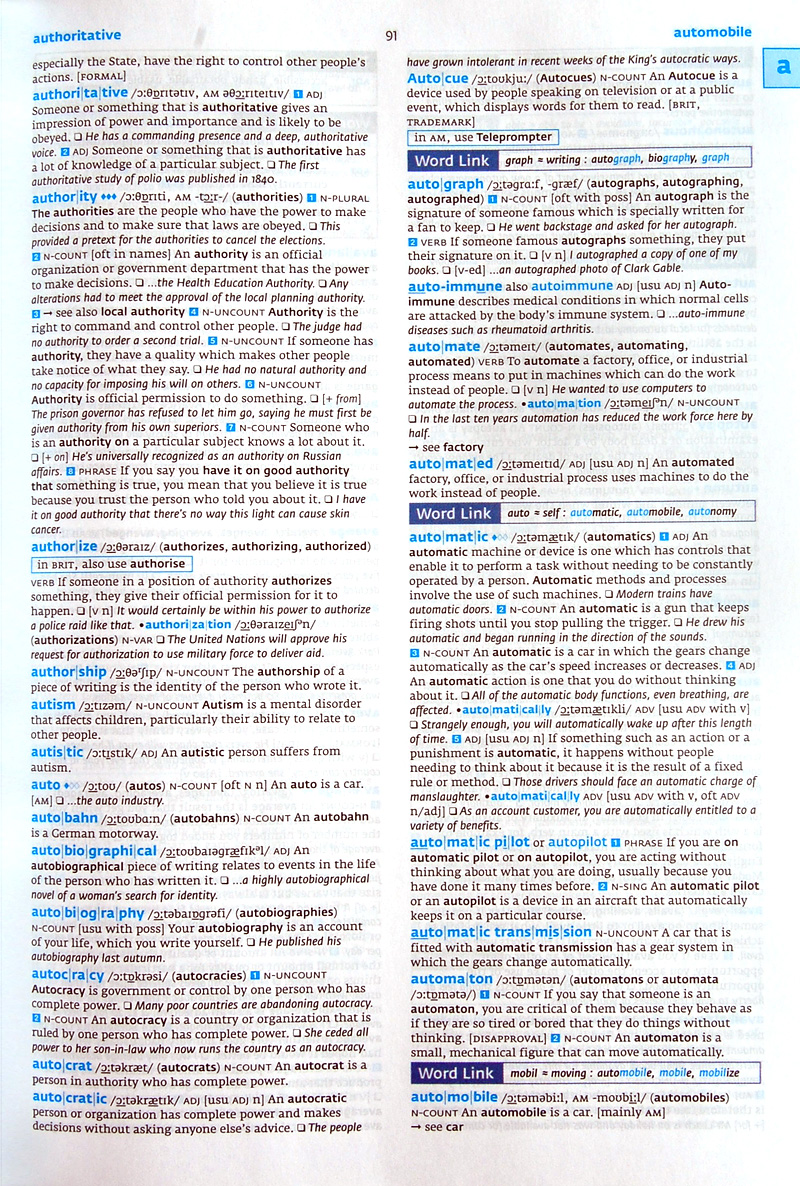
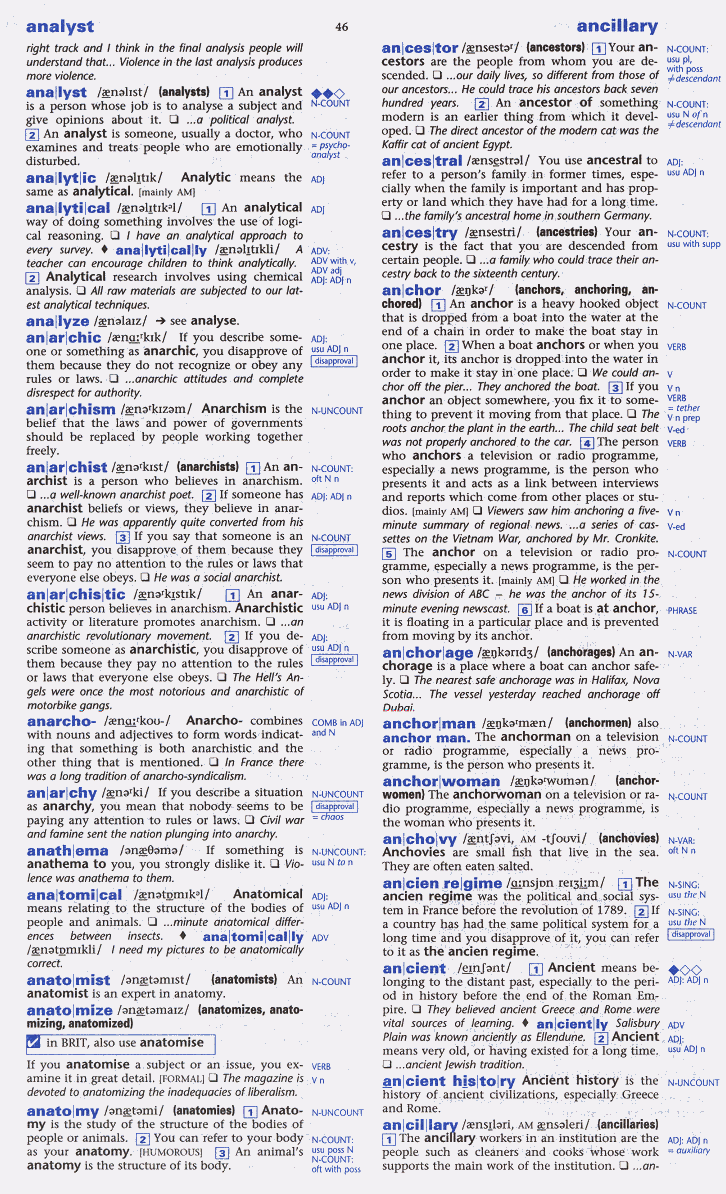
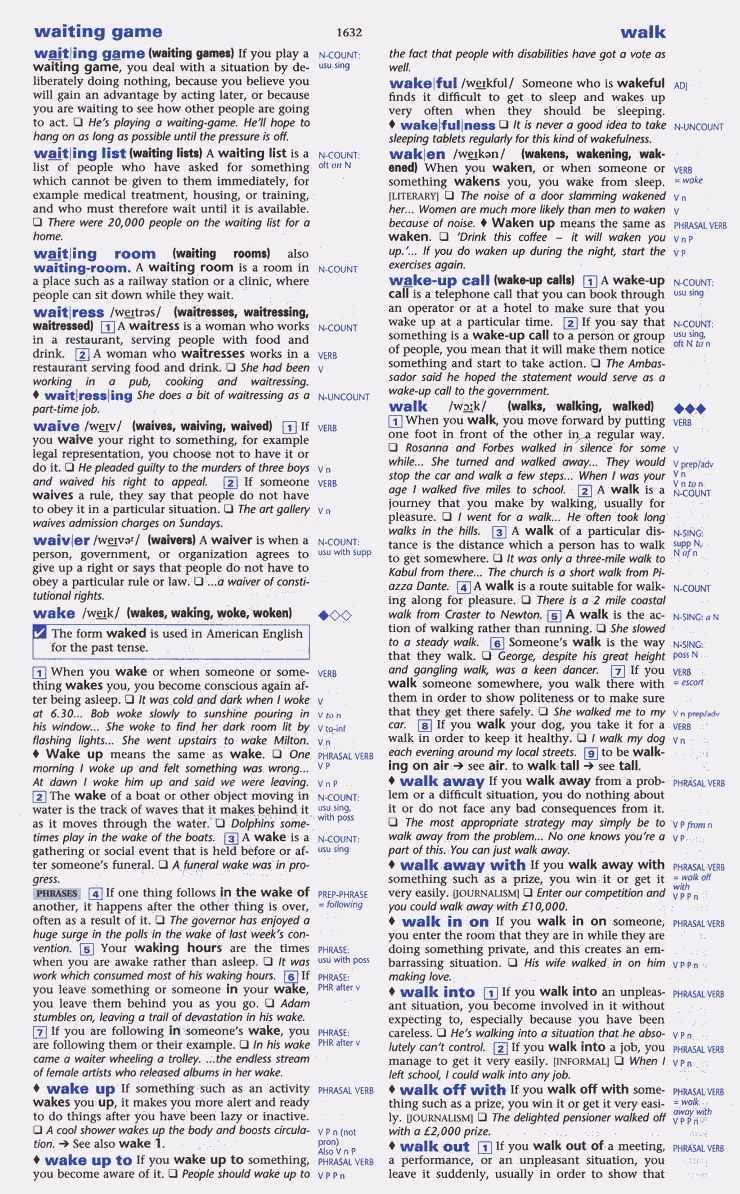
- The design is nicer, with better paper quality and more colors (see example pages)
- Some illustrations next to entries (the previous edition only had illustrations in a separate section)
- For some words, there are “Word Partnership” boxes which give common phrases (collocations) with the word (see example page 1).
- There are also occasional “Thesaurus” boxes (with synonyms) and “Word Web” boxes (short paragraphs which discuss a topic, e.g. pollution, using many different words related to the subject).
While the book is quite good, the software on the 6th edition CD-ROM is the worst software dictionary that I have ever seen. Even the most basic features like search are either very slow or buggy. There are no phonetic transcriptions, there is no Word Bank, and the quality of recordings is horrible. This product feels like it was designed to make your experience miserable. Avoid the 6th edition, unless you don’t have a computer and have to use a book dictionary.
The rest of this review is based on the fourth and fifth editions of the Collins COBUILD Advanced Learner’s English Dictionary (see below).
4th / 5th edition
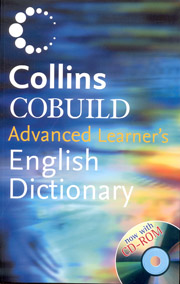
The fourth edition of the Collins COBUILD Advanced Learner’s English Dictionary was published in October 2003. The fifth edition, published in 2006, introduced only cosmetic changes — some new, “trendy” words (e.g. spyware) were added, others were removed. Both editions of the book have the same number of pages and are very difficult to tell apart.
On the other hand, the 5th edition of the CD-ROM is much better than the 4th edition. It finally has phonetic transcriptions, and many bugs have been fixed (for example, you can now copy & paste part of an entry to another application). The 5th edition is the best software version of the Collins COBUILD English Dictionary to date.
3rd edition
The third edition of this dictionary (published in 2001) was titled Collins COBUILD Advanced Learner’s English Dictionary. There were considerable differences between the 4th edition and the 3rd edition, but they don’t matter anymore, because the only editions you can get today are the 4th and 5th. I still use the 3rd edition of the CD-ROM because it has about 30% more example sentences than the latest versions.
The basics
- The Collins COBUILD Advanced Learner’s English Dictionary (CCED) is an English-English (monolingual) dictionary, so it is written only in English. Beginners may be afraid of this, but we think that learners should begin to use an English-English dictionary as early as possible. If you can understand this article, we think you should use a monolingual dictionary.
- It has example sentences for almost every meaning of every word. Example sentences are the most important thing in a dictionary for learners, because they show you how to use a word.
- It has phonetic transcriptions, so you can read how to pronounce every word. The transcriptions are based on the International Phonetic Alphabet (IPA) — the most popular phonetic alphabet in the world.
- It is a software dictionary as well as a paper one — a CD-ROM is included with the book.
In conclusion, the Collins COBUILD Advanced Learner’s English Dictionary has all the necessary features of a dictionary for the serious learner. Now let’s see what is special about this dictionary...
A corpus-based dictionary
The name COBUILD stands for “Collins Birmingham University International Language Database”. It means that the dictionary is based on a “corpus” — a collection of British and American newspapers, books, TV programs, real-life conversations, etc. The editors analyzed the corpus with a computer, getting useful information about the English language.
This method has serious advantages (more on that below), and the latest dictionaries from other big publishers (like Longman and Oxford) are now based on a corpus, too.
Full-sentence definitions
Probably the most interesting thing about the Collins COBUILD Advanced Learner’s English Dictionary are its definitions. They are full sentences, not phrases. For example:
If something comes to fruition, it starts to succeed and produce the results that were intended or hoped for.
Because this definition is a full sentence, it gives you a lot of information. It shows that fruition is usually used in the phrase “come to fruition”. How did the editors know that? They used a computer to analyze the COBUILD corpus.
What does this information give you? You can easily build your own correct sentences with the word. For example, you can say “His hopes finally came to fruition” or “Will my plan ever come to fruition?”.
Look at a typical definition of fruition in a dictionary which doesn’t have full-sentence definitions:
After reading this definition, you might use the word fruition in incorrect ways. You might think it is correct to say “What about your fruition?” or “Is this book your greatest fruition?”. But both sentences are bad English.
Look at another definition from the CCED and compare it with a definition from the the Oxford Wordpower Dictionary:
When a dog wags its tail, it repeatedly waves its tail from side to side. —CCED
wag = to shake up and down or move from side to side —Oxford Wordpower
The first definition tells you that the word wag is often used to talk about a dog. It says: This is how “wag” is used 90% of the time. If you know that “wag” describes the motion of a dog’s tail, you can probably figure out what it means in other contexts.
The second definition is too broad. It tries to cover all the possible meanings of wag and, as a result, tells you less. If you come across the word wag in a book, it will probably help you understand it, but it will add nothing to your practical knowledge, and can even be harmful.
The definitions in the CCED do not simply tell you what a word means, they tell you how to use it — in what phrases, in what grammar structures, in what context. At the same time, you can understand them easily.
The definitions are also very “natural”. They are sentences that could be said by your English teacher or any native speaker of English. Having this dictionary almost feels like having a native speaker friend to answer your questions about English.
We encourage you to look at other examples of definitions from the CCED with our comments.
Example sentences
Our rule for dictionaries is: The more example sentences, the better. The Collins COBUILD Advanced Learner’s English Dictionary has at least one example sentence for almost every meaning of every word. The number of examples per definition is about the same as in other modern dictionaries for learners.
The interesting thing is how these examples were chosen. For example, to choose the example sentences for the verb play, the editors used a computer to search the corpus and find all the sentences with the word play. The results showed that people often use play in phrases like “play an important role in something” and “play an active part in something”. So there should be at least one example sentence which has the word play in such a phrase.
Thanks to this kind of corpus research, the example sentences in the CCED show how a word is really used by speakers of English. They are not invented by an editor; they are natural. Just like the definitions, the examples focus on the most important phrases, grammar structures, contexts, etc. which contain the word.
Pronunciations
Phonetic transcriptions in the CCED are based on A. C. Gimson’s phonemic system, which uses symbols of the IPA to represent English phonemes. Gimson’s system was first used in 1967 in the English Pronouncing Dictionary, and is now used by most dictionary publishers.
-
Like most recent dictionaries, the CCED uses a couple useful (non-phonemic) symbols
not used by Gimson:
ʳiuəlandən. For an explanation of these symbols, see our phonetic chart. -
Unfortunately, this edition of the CCED ignores the fact that vowels like
ɪ,ʊ, andæare often pronounced likeə. For example, this goes for theæin admonish and admit, theɪin possible and private, theʊin careful. In all these cases, the CCED simply omits the “ə” version, which is the standard in normal speech. If you followed the transcriptions in the CCED, your pronunciation of some words would sound quite unnatural. -
In some cases, the CCED takes the “no
ə” policy to the extreme. Who pronounces adventure and advance with anæat the beginning? -
The dictionary tries to represent both British and American English with one transcription. The transcriptions use mostly British phoneme symbols and the dictionary gives rules for “converting” these symbols into American sounds. For example, it explains that all
ɒsymbols are reallyɑ:in American English. We think this is a sensible system, because it results in short, readable transcriptions.Here are example transcriptions from the CCED and what they mean in British and American English:
word CCED transcr. British American pot pɒtpɒtpɑ:tgo goʊgəʊgoʊfair feəʳfeəʳfernear nɪəʳnɪəʳnɪrlure lʊəʳlʊəʳlʊrbarn bɑ:ʳnbɑ:nbɑ:rnmother ˈmʌðəʳˈmʌðəʳˈmʌðɚbird bɜ:ʳdbɜ:dbɝ:d
Note: Phonetic transcriptions are included on the 5th edition CD-ROM, but not the 4th edition.
Coverage of American English
Unfortunately, we have found that the CCED cannot be fully trusted when it comes to information on American English:
-
For the word fast, the CCED lists two pronunciation alternatives
(
/fɑ:st/and/fæst/), but it does not mention that only/fæst/is correct in American English. This problem affects many similar words: ask, pass, castle, dance, chance, etc. -
Accent is transcribed
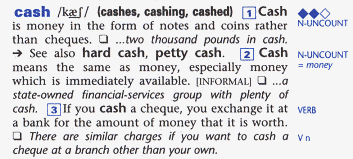
/ˈæksənt/with no mention of the only correct American pronunciation/ˈæksent/. Similarly, sloth is transcribed/sloʊθ/, although it is pronounced/slɔ:θ/in American English. - In the entry for wake, the dictionary claims: “The form waked is used in American English for the past tense.”. This is plain wrong. In the American corpus, waked occurs about 100 times; woke — nearly 7,000 times. The CCED is mistaken about some other irregular verbs as well: it claims that Americans say burned instead of burnt and spit instead of spat (they say both).
- In the entry for get, the CCED states: “Gotten is an American form of the past tense and past participle.” This is a gross mistake; gotten is the past participle (e.g. I have gotten angry), but certainly not the past tense form. Nobody would ever say: I gotten an Xbox for Christmas.
Word frequency
The dictionary gives information on word frequency. The most frequently used English words are labeled with 1 to 3 diamonds (♦ to ♦♦♦). These are words which occur most frequently in the COBUILD corpus.
“Access to English” section
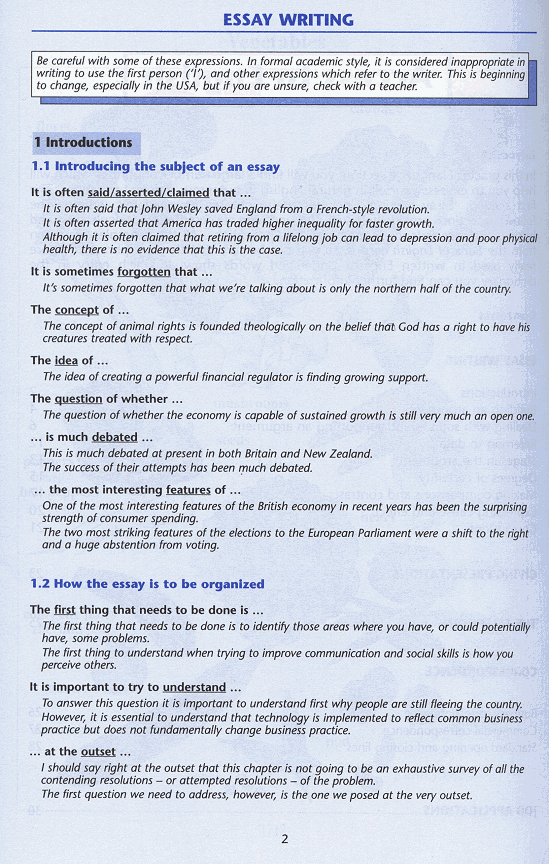
The CCED has a 30-page “Access to English” section which provides useful example sentences and phrases that you can “steal” when writing essays, giving presentations, telephoning, writing business correspondence, and applying for a job (there is a chapter for each of these activities). Reading such sentences is a great way to build your English writing/speaking skills in a short time.
Note: The “Access to English” section is not included on the CD-ROM. The 6th edition of the book has two sections: “Speaker’s Handbook” and “Writer’s Handbook”, but the “Writer’s Handbook” has virtually no sentence patterns — it is focused on basic grammar and spelling errors.
Our personal experience
We first saw the CCED (the 2nd edition) in 1999, when only the paper version was available. We immediately felt it was something special. Normally, we use only software dictionaries, but we started using the paper COBUILD dictionary, because we liked the contents so much.
Today, we still like learning with the dictionary very much. When we need to look up a word, it helps us understand it and use it in our own sentences. Often, we look up one word, and then we feel like reading another one — the definitions and examples are so nice. Sometimes, we even like to read the CCED just like a book.
Conclusions
When you look up a word in a dictionary, you should be interested in what the word means. But you should also ask the question “What can I do with it?”. The CCED answers this question very well by giving the most important phrases and grammar structures containing the word — both in the definition and example sentences.
Together, the definition and the example sentences give you an almost complete picture of how a word is used in the English language. After you read them, the word is usually “yours” — you can use it easily in your own sentences.
| PRO | CON |
|---|---|
|
|
CD-ROM
If you are learning English seriously, you should be more interested in the included CD-ROM than in the book. Here is more information about the CD-ROM.