How to buy a good English dictionary
An English dictionary is the most important thing you will need when learning English. A good dictionary will help you learn hundreds of new words, improve your pronunciation and grammar. You can read more about why it is important to get a good English dictionary in another article.
English-English dictionaries
When you think of a dictionary, you usually think of a bilingual dictionary. For example, an English-German dictionary or a French-English dictionary. There is also another kind of dictionary: an English-English (monolingual) dictionary.
This type of dictionary is written only in English. English words are not translated; they are defined or explained in English. For example, if you look up the word criticize in an English-English dictionary, you will read something like this:
Why English-English (monolingual) dictionaries are better than bilingual dictionaries:
- Monolingual dictionaries are simply more advanced products. The best dictionaries from the top publishers (like Longman, Oxford or Collins) are monolingual. And the best monolingual dictionaries are far ahead of the best bilingual dictionaries — they have more example sentences, more accurate pronunciations, phrasal verbs and idioms, word frequency information, etc.
- English definitions are real English phrases with grammar and words. If you read them regularly, you will automatically memorize the grammar and words.
-
English definitions let you learn more. You will often
look up
a word because it was part of the
definition for another word. For example, if you
look up
the word naughty, you might read:
If you say that a child is naughty, you think that he or she is behaving badly or is disobedient. —Collins COBUILD English Dictionary
If you don’t know the words disobedient and behave, you will have to look them up. So instead of one word, you will have learned three words!
Don’t be afraid of using an English-English dictionary. If you can understand this article, you can definitely understand the definitions in an English-English dictionary.
Dictionaries for learners vs. dictionaries for native speakers
There are two kinds of English-English dictionaries: dictionaries for learners and dictionaries for native speakers. Dictionaries for native speakers are used by Americans, Britons, etc. to look up rare words, such as inextricable or tintinnabulation. Dictionaries for learners are used by people who are learning English as a second language.
Dictionaries for native speakers usually have more words than dictionaries for learners, but the definitions are complicated, and there are fewer example sentences. Therefore, whenever possible, you should be using dictionaries for learners. You should use “native” dictionaries only in special situations: for example, when your learner’s dictionary does not have the word you’re looking for.
Software dictionaries
If possible, get a software dictionary instead of a paper one. Here are some reasons why:
- Quick searching. Software dictionaries let you look up words very quickly. Typing a word on your keyboard is much, much faster than turning pages in a large, heavy book.
- Easy copying. If you’re making your own SRS collection for learning English, you can select whole sentences and definitions in the dictionary, and copy them to your new items.
- Recordings. In many software dictionaries, you can listen to recordings which show you how to pronounce a word. Recordings cannot replace phonetic transcriptions (see below), but they are certainly a useful feature.
- More information/clearer layout. Paper dictionaries have limited space, which is why they are printed in a small font and the layout is very crowded. A computer dictionary has more space, so it can give more information (e.g. more example sentences) or it can present the same information in a clearer way (bigger font, blank lines, etc.).
Why is quick searching so important? Because if you want to learn English well, you should look up lots of words, and a paper dictionary discourages you from that. You want to look up a word, you look at the huge book with 1500 pages, think “Ah, never mind”, and you never learn that word. Once you see how quick it is to use a software dictionary, you will start looking up hundreds of words every week. And your English will get a huge boost.
Example sentences for every word
A good dictionary must give example sentences for every word. Example sentences are English sentences which contain a word:

—Longman Dictionary of English Language and Culture, Second Edition
Example sentences are not just helpful — they are actually more important than definitions. While a definition tells you the meaning of a word and (sometimes) gives you some grammatical information, example sentences have at least three advantages:
- They let you check if you’ve understood the definition correctly. The meaning of a word can become much clearer if you read a few sentences with the word.
- They show you how to use a word in sentences. Many words “go with” certain grammar structures (e.g. important is often used in the phrase “It is important to...”) or words (e.g. weather goes with forecast and not e.g. prediction). Example sentences present this information in a clear way. You can easily imitate them to make your own natural sentences.
- They program your brain to produce correct English sentences. If you read an English sentence, there is a good chance that it will stay in your head, and that you will be able to build a similar sentence (or part of a sentence) to express your thoughts another day. So the more English sentences you read, the more you can produce.
(Read more about why example sentences are so important)
Phonetic transcription for every word
Standards of transcription
A good dictionary must give phonetic transcription for every word. Phonetic transcription tells you how to pronounce a word. Ideally, the transcription should be based on the International Phonetic Alphabet (IPA), which is the standard phonetic alphabet used by linguists all over the world. Here is what IPA-based phonetic transcription looks like:

Here, the phonetic transcription is marked in yellow. It tells you that image is pronounced like this.
Generally, dictionaries from UK publishers (Cambridge, Collins, Longman, Oxford) use IPA-based transcriptions, while dictionaries published in the USA (Random House, Merriam-Webster, etc.) use their own systems. Some dictionaries give phonetic transcription only for “the most difficult words” (usually less than 5% of all words). These are almost useless to learners, because all English words are difficult if you are not a native speaker. Avoid them.
If you want to check if a dictionary uses IPA-based transcription, look at the pronunciation symbols used in the dictionary and compare them with the IPA symbols in our phonetic symbols chart.
Phonetic transcriptions vs. recordings
Virtually all software dictionaries nowadays have audio recordings. If you can listen to a native speaker pronouncing a word, is there any point in looking at phonetic transcriptions? Yes, for reasons explained fully in this article. To put it shortly:
-
Transcriptions can help you recognize all the sounds in a word.
For example, if look up the word boot and listen to its recording,
you may not notice that it has the “long u” sound (as in who) and not the “short u” (as in good).
If you also look at the phonetic transcription
/buːt/and see theuːsymbol (and know what it means), there’s a bigger chance that you will notice and remember the correct pronunciation. - Dictionaries have more transcriptions than recordings. For example, the transcriptions may show two ways to pronounce a word, but the recording will show only one.
- There are situations when you cannot listen to sound – for example, the computer you’re using has no speakers, you don’t want to disturb other people, you are in a noisy environment and can’t hear the sound, etc.
- Reading a transcription is often faster than clicking a button and listening to a recording.
Other things to look for
- Simple definitions. The definitions should be easy to understand. If something can be simple, it should be simple. See example of a simple dictionary definition.
- Useful definitions. If possible, the definitions should tell you how to use the word. Generally, longer definitions are better, because they give more information. See example of a useful dictionary definition.
- Both British and American English. Your dictionary should have both British and American words. Also, both British and American pronunciation should be given, because both are used in today’s world.
- Phrasal verbs and idioms. There are special dictionaries for these, but every English dictionary should have the most common phrasal verbs and idioms.
- Pictures. Sometimes you can understand a picture better than a definition. See this example.
- User friendliness. Do you have to click 4 times to look up a word, or can you just start typing? Can you scroll the page easily? Is the layout clean and readable? Can you copy text to another application easily?
- Search engine. If a word has many spellings (e.g. hard-pressed/hard pressed), it shouldn’t matter which one you search for. It shouldn’t matter if you type “between a rock and a hard place”, “caught between a rock and a hard place”, “hard place” or “rock” — the phrase you’re looking for should always be returned in the search results.
- Software speed. Do you have to wait 10 seconds for the dictionary to load? Does it feel sluggish when you search or scroll the page?
How many dictionaries?
In my experience, it is definitely a good idea to use at least two large (software) dictionaries. Why? It’s about example sentences. Two example sentences are better than one; four are better than two. With more examples, you have a more complete picture of how a word is used and you can express more in English yourself.
Another reason is that dictionaries sometimes give incomplete information on phonetics, especially on American pronunciation.
For example, the
Collins COBUILD Advanced Learner’s English Dictionary
says that castle is pronounced
/ˈkɑ:səl/ or /ˈkæsəl/, but does not
tell you that only /ˈkæsəl/ is used in American English. It helps to have another dictionary
to get a “second opinion”.
Mobile dictionary
Another good idea is to have a dictionary that you can carry with you. If you go to English classes, you can use this mobile dictionary to look up the words that are taught in class. Such a dictionary will also be very useful if you read English books or listen to podcasts away from home.
There are currently three ways of using a mobile dictionary:
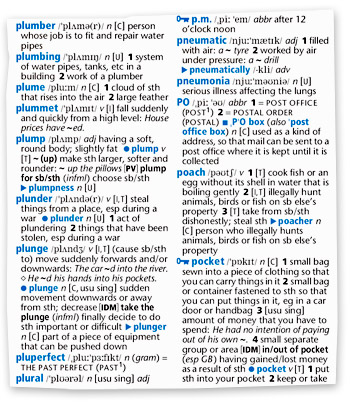
- You can get a pocket version of a book dictionary. I have used the Oxford Pocket Learner’s Dictionary (example page), which has phonetic transcriptions and even some example sentences.
- You can get a special software dictionary for your mobile device, e.g. a smartphone, PDA, etc. Mobipocket has a great selection of mobile dictionaries from publishers like Longman, Oxford, Collins and Merriam-Webster. Their dictionaries do not have audio recordings, but they do have phonetic transcriptions. There are also iPhone versions of advanced learner’s dictionaries from Longman and Cambridge.
- If you carry your notebook, tablet or netbook with you, you can simply install your normal software dictionary on it.
- If you have a mobile device with an Internet connection, you can use one of the online dictionaries, such as: Oxford Advanced, Merriam-Webster Learner’s, Cambridge Advanced or Macmillan Dictionary.
Specific recommendations
See our comparative review of dictionaries for English learners to find out which software dictionaries are currently the best.